
The commission had earlier projected a 2.5 per cent fall in the farm output due to weak monsoon but expects the drop to be less than that.

India appears poised to sustain its growth in a more durable way than before with the economy carrying the momentum from FY23 into the current fiscal year, the Annual Economic Review for 2022-23 released by the finance ministry on Thursday said. However, the report cautioned that escalation of geopolitical stress, enhanced volatility in global financial systems, sharp price correction in global stock markets, a high magnitude of El-Nino impact, and modest trade activity and FDI inflows, are factors that could constrain the pace of growth. "Should these developments deepen and dampen growth in the subsequent quarters, the external sector may challenge India's growth outlook for FY24," the finance ministry said.

'The long-term impact of elections is minimal.'

In line with other rating agencies and economic organisations, Crisil on Friday forecasted 7.1 per cent economic growth in the wake of an excellent monsoon, but warned that the fiscal deficit would overshoot the target besides lower export growth.

In April, the World Bank had projected India's GDP would grow at 6.1 per cent in the current financial year and at 6.7 per cent the following year.
Global credit rating agency Standard & Poor's on Thursday said India's economic growth may fall marginally to 7.5-8 per cent, but inflation outlook remained stable at 5-5.5 per cent in 2007.

Analysts expect modest recovery in Indian economy.

"Growth is expected to moderate gradually in China... pick up in India, and remain broadly stable in the Asean-5 region."

Stating that India's economic stimulus was not adequate, Banerjee said, the measures did not increase consumption spending of lower income people as the government was not willing to put money in the hands of the low income population.

The US Federal Reserve on Wednesday (local time) raised interest rates by 75 basis points (bps) or three-quarters of a percentage point in the boldest move since 1994.

Top laggards in the Sensex pack included HDFC, ICICI Bank, TCS, HCL Tech, Kotak Bank, Asian Paints, TechM and HUL, dropping up to 2.67 per cent.

Bullish over robust fundamentals and improving macroeconomic conditions, industry leader Deepak Parekh on Saturday said India currently has "exceptionally good conditions" in place to aspire for 10 per cent economic growth but much needs to be done to achieve that target.

Official data released on Friday said the GDP is estimated to have grown by 5.7 per cent for the April-June period, as against a 4.6 per cent growth notched for the same period year ago.

The overall FPI inflows should move into the range of $15-20 billion in fiscal 2017 with equity dominating with $10-15 billion and debt with $5 billion

The July-September quarter GDP numbers are due on November 30.
India decisively withstood global headwinds in 2023 and is likely to remain as the world's fastest-growing major economy on the back of growing demand, moderate inflation, stable interest rate regime and robust foreign exchange reserves. Despite widespread pessimism witnessed among the developed nations and the worsening geopolitical situation, India recorded a gross domestic product (GDP) expansion of 6.1 per cent in the March quarter. The growth moved up to 7.8 per cent in the June quarter and was 7.6 per cent in the September quarter. For the first six months of this fiscal, the growth was 7.7 per cent.
Weaker demand for Indian exports and higher financing costs will lead to a deceleration in India's gross domestic product (GDP) growth rate to 7.9 per cent in 2008, the International Monetary Fund has said.The IMF's growth projections for India are in line with other estimates, including that of the Asian Development Bank, which pegged the 2008-09 growth at 8 per cent.

Moody's Investors Service on Wednesday raised India's economic growth estimate for 2023 to 5.5 per cent from 4.8 per cent pegged earlier, on the back of a sharp increase in capital expenditure in the Budget and a resilient economic momentum. It however revised downwards India's growth estimate for 2022 to 6.8 per cent from 7 per cent pegged in November last year. In its February update to Global Macro Outlook 2023-24, Moody's raised the baseline 2023 real growth projections "meaningfully" for several G20 economies, including the US, Canada, the Euro area, India, Russia, Mexico, and Turkiye, accounting for a stronger end to 2022.
The chief statistician feels there should be a rebound after companies integrate and adopt the GST system

Analysts and economists have hailed the fiscal projections in the interim Budget, saying the lower fiscal deficit forecast shows that the government, even in an election year, is serious about fiscal consolidation and that the numbers look achievable. According to Devendra Kumar Pant, the chief economist at India Ratings, the two broad themes of the interim Budget are fiscal consolidation and stepping up focus on agriculture/rural to course correct, to some extent, the differential benefits of the ongoing economic growth that's tilted in favour of upper-income bracket/urban households. The projected fiscal deficit numbers for FY24 and FY25 suggest that the government is serious about achieving the fiscal consolidation path of 4.5 per cent fiscal deficit by FY26, and given the nominal GDP growth assumption and revenue buoyancy, the target appears plausible, Pant said in a note.

With the government claiming that the economy has been growing robustly and the Opposition refuting these claims, the common man is none the wiser, says Rajeev Sharma.

Fitch Ratings says in a report published on Thursday that the spillover effects of a weaker rupee have not significantly hurt India's creditworthiness, and hence would not trigger any rating action as this point.
Indian economy is likely to end this fiscal with over 6 per cent growth backed by industrial recovery and impressive performance of the service sector, according to ICICI Bank chief executive K V Kamath.

Fitch Ratings on Tuesday affirmed India's sovereign credit rating at 'BBB-' with a stable outlook, saying the rating derives strengths from the country's robust growth outlook and still-resilient external finances. It said India's robust medium-term growth outlook is a key supporting factor for the rating. A clear improvement in corporate and bank balance sheets, which were under strain prior to the pandemic, is likely to facilitate a steady acceleration in investment in the coming years.

Indian economy is set for a 'goldilocks' period -- used to describe a timeframe of high growth and low inflation -- while it can become Asia's fastest growing economy in 2016, Japanese financial major Nomura said.
Economic think-tank National Council of Applied Economic Research expects India's Gross Domestic Product growth to decelerate to 8.3 per cent during current fiscal

India's exports declined by 2.83 per cent to $33.90 billion in November this year compared to $34.89 billion a year ago, government data released on Friday showed. Imports also declined to $54.48 billion in the month under consideration, as against $56.95 billion recorded in November 2022.

Indian economy is expected to clock an average growth rate of 6.7 per cent till 2026-27 fiscal driven by domestic consumption, S&P Global Ratings senior Economist (Asia Pacific) Vishrut Rana said on Wednesday. He said the economic growth in the current fiscal is expected to come in around 6 per cent, lower than 7.2 per cent clocked in 2022-23. "We are seeing some headwinds from the trade side which is affecting activity and that is one of the factors that is affecting growth this year," Rana said at a webinar.
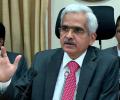
To a specific question on the change in RBI's stance from "neutral" to "accommodative", Das said it means that there will not be any rate hike from here on.
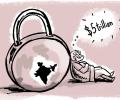
The wait for India to become a $5-trillion economic powerhouse by 2024-25 (FY25) is going to take longer than what the finance ministry had originally intended, according to the International Monetary Fund (IMF). The vision will instead be achieved in 2028-29 (FY29), reveals the IMF data, illustrating a four-year delay. Chief Economic Advisor (CEA) V Anantha Nageswaran had in February said India would become a $5-trillion economy by 2025-26 or the following year, on the back of 8-9 per cent sustained growth rate in real gross domestic product (GDP). However, the IMF data conveys that the economy will be $4.92 trillion in FY28, clearly alluding to the fact that the target will be realised in FY29.

Corporate India handed over an average increment of 8 per cent in 2021, and early estimates reveal that average increment for 2022 is expected to increase to 8.6 per cent in line with a healing economy and improving confidence, according to a Deloitte survey. As per the second phase of Deloitte's Workforce and Increment Trends survey 2021, 92 per cent companies gave an increment in 2021 at an average of 8 per cent, compared with only 4.4 per cent in 2020, where just 60 per cent companies had extended a pay hike. For 2022, average increment is expected to increase to 8.6 per cent, at par with the pre-pandemic levels of 2019, the survey said, adding that about 25 per cent companies surveyed have projected a double-digit increment for 2022.

Equity benchmark Sensex declined over 215 points on Wednesday, weighed by losses in index heavyweight Reliance Industries, Bajaj Finserv and Tata Steel, after the Reserve Bank raised the key interest rate by 35 basis points. Subdued Asian markets and continued selling by foreign investors also weighed on sentiment, traders said. Extending its losses for the fourth straight session, the 30-share BSE Sensex ended 215.68 points or 0.34 per cent lower at 62,410.68.

Nirmala Sitharaman is proving to be a better finance minister than her initial rookie status might have led people to expect, observes T N Ninan.

India's economy is moving towards a higher growth trajectory and is likely to grow at around 10 per cent in 2021-22, Economic Advisory Council to the Prime Minister (EAC-PM) chairman Bibek Debroy said on Wednesday. "I am confident that we are on a path towards a higher growth trajectory, higher poverty reduction, higher employment, and a prosperous, more developed and better governed India. "I think it is, more or less, agreed that the real rate of growth this year (FY2022) is going to be around 10 per cent," Debroy said at an SBI event. At the beginning of FY2021-22, the forecasts for real growth were in the 8.5-12.5 per cent range, he noted.

Undeterred by the stock market volatility, uncertainty due to the Ukraine-Russia war and high inflation, equity mutual funds continue to remain attractive choice for investors for the 15th straight month, registering a net inflow of Rs 18,529 crore in May on robust SIP numbers. This was higher than Rs 15,890 crore net inflow in April, data from the Association of Mutual Funds in India (AMFI) showed on Thursday. Equity schemes have been witnessing net inflow since March 2021, highlighting the positive sentiment among investors.

The Centre could better its fiscal deficit at 6.6 per cent of GDP in this financial year on stronger-than-expected revenue buoyancy, even if the budgeted disinvestment target is not met, Fitch Ratings has said. The international rating agency had last week kept the sovereign rating unchanged at 'BBB-' with a negative outlook, and said that the risks to India's medium-term growth outlook are narrowing with rapid economic recovery from the pandemic and easing financial sector pressures. In an email interview with PTI, Fitch Ratings Director (Asia-Pacific Sovereigns) Jeremy Zook said the two key positive triggers that could lead to a revision of the outlook to stable are implementation of a credible medium-term fiscal strategy to lower debt burden and higher medium-term investment and growth rates without the creation of macroeconomic imbalances, such as from successful structural reform implementation and a healthier financial sector.

Morgan Stanley says, India will clock 7.9 per cent GDP growth in current fiscal.

The Nikkei India Manufacturing Purchasing Managers Index (PMI), fell from 52.1 in February to a five-month low of 51.0 in March, indicating the slowest improvement in operating conditions recorded by the survey since last October.

The Indian economy remains on track to regain its position as the world's fastest-growing major economy after official estimates on Friday put the expansion at a tempered 9.2 per cent this fiscal amid concerns over the impact of a resurgent virus on the fragile recovery. The growth in the gross domestic product (GDP) of 9.2 per cent in April 2021 to March 2022 fiscal (FY 2021-22) given by the National Statistical Office (NSO) in its first advance estimate compares with 9.5 per cent expansion forecast by the Reserve Bank of India (RBI) last month. The economy had contracted by 7.3 per cent in the previous financial year.

Expenditure cuts necessitated by slowing revenue growth, weak industrial activity worrisome portents
